If you're planning a fiber cement siding installation in the Portland, Oregon or Vancouver, Washington area, there's a critical decision that happens before a single plank goes up: what to do about the sheathing underneath. At KVN Construction, we see it often. A homeowner budgets for a beautiful new fiber cement exterior, and then the crew pulls off the old siding to find sheathing that's soft, delaminated, or water-stained from years of hidden moisture intrusion.
This matters more with fiber cement than with lighter siding materials. Fiber cement is denser and heavier than vinyl or engineered wood, so it depends on a solid, well-fastened sheathing layer underneath to hold up over the long term. A siding replacement is the best, and often the only affordable, opportunity to inspect, repair, or upgrade that sheathing before it's covered for another 30-plus years. Here's what homeowners in our region should know.
Why Sheathing Matters More Here Than Almost Anywhere
The Pacific Northwest's climate is uniquely hard on exterior wall systems. Portland and Vancouver both see a long rainy season, roughly from October through May, high ambient humidity even in the drier months, and wind-driven rain that tends to hit west- and southwest-facing walls the hardest. Sheathing sits at the center of your home's moisture management system. It's the structural layer between your siding and your framing, and it needs to survive decades of wetting and drying cycles without losing strength.
That's why the sheathing conversation deserves just as much attention as the siding material conversation.
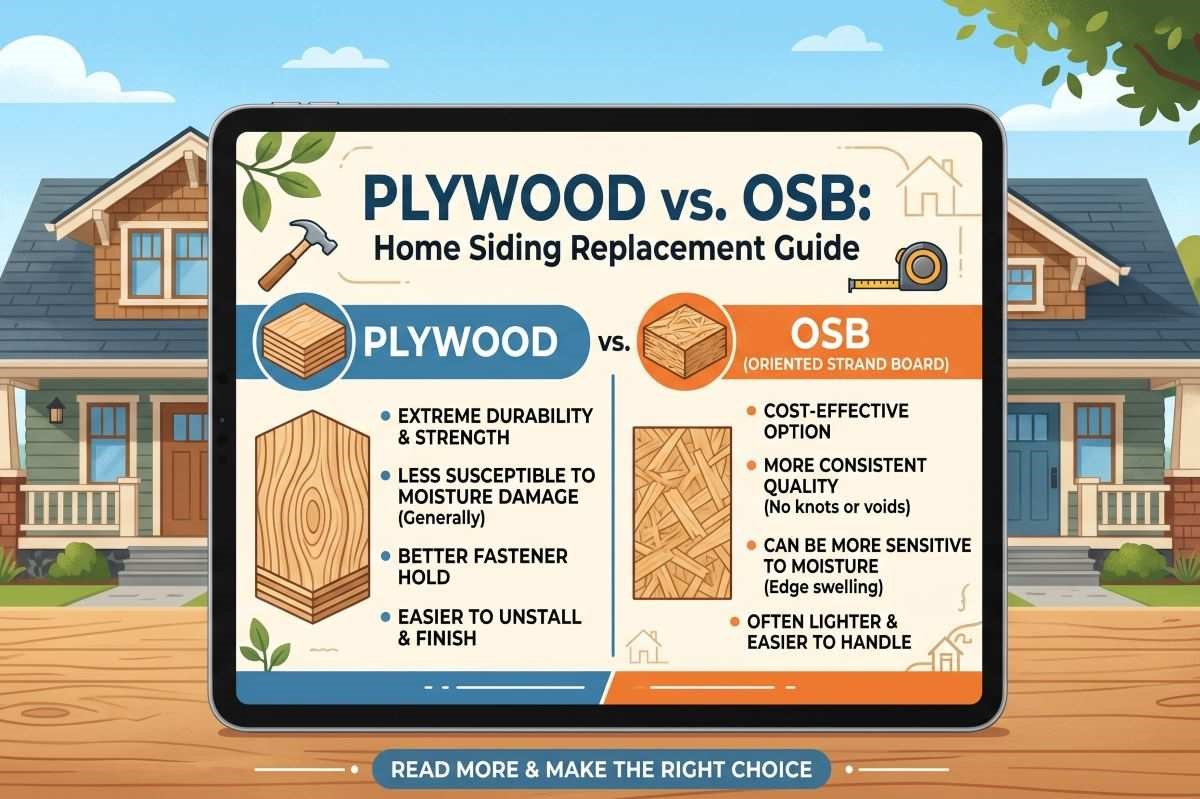
Plywood vs. OSB: What's Actually Different
The two standard sheathing materials are plywood and oriented strand board (OSB). Both are code-approved and structurally sound when installed correctly, but they behave differently around moisture, which is the deciding factor for our climate.
Plywood is made of cross-laminated wood veneers. It absorbs water somewhat quickly if exposed, but it also dries out relatively fast and tends to return close to its original shape. That resilience matters a lot during construction, when sheathing can sit exposed to the elements for days or weeks before the weather-resistant barrier and siding go on.
OSB is made of compressed wood strands bonded with resin. It's more affordable and performs comparably to plywood in dry conditions, but once it gets wet, it swells at the panel edges and dries much more slowly. Repeated wetting, the kind that's hard to avoid during a rainy Northwest build season, can cause lasting thickness swelling and gradual strength loss.
Our general recommendation for this region:
- Roof sheathing: Plywood, particularly on projects where scheduling could leave sheathing exposed between tear-off and dry-in.
- Wall sheathing under fiber cement: Either material can perform well behind a properly installed weather-resistant barrier (WRB) and rain screen system, but we lean toward recommending plywood for homes getting fiber cement siding. Fiber cement is fastened directly through the siding into the wall assembly, and it's heavier per square foot than vinyl or wood alternatives, so it benefits from sheathing with strong, consistent nail-holding strength over the life of the product. Plywood's tolerance for our region's wetting and drying cycles also reduces the risk of edge swell or softening around fastener points over time, something worth protecting given fiber cement is a long-term investment, often installed with a 30- to 50-year expectation.
Options for Homeowners During a Siding Replacement
When we open up a wall during a siding project, homeowners generally fall into one of these situations, and each has a different path forward.
1. Sheathing Is Sound, No Replacement Needed
If the existing sheathing is structurally solid and dry, we don't recommend replacing it just for the sake of it. In this case, the project focuses on upgrading the weather-resistant barrier, flashing details, and ventilation gap before new siding goes on.
2. Localized Repair
Often, moisture damage is isolated to specific areas: around old window flashing, near ground contact, or below a leaky gutter. In these cases, we can cut out and replace only the damaged sections rather than re-sheathing the entire wall, which keeps costs down while still solving the underlying problem.
3. Full Re-Sheathing
When damage is widespread, or when a home is switching from a lighter siding material (vinyl, aluminum, or aging wood lap) to fiber cement, a full re-sheathing gives you a clean, uniform structural base built for the new material's weight and fastening requirements. This is also the point where many homeowners choose to add a layer of rigid foam sheathing before the WRB and siding go on. It's a smart move in our climate for both energy efficiency and added moisture protection, and it's fully compatible with a proper fiber cement installation when furring or fastening details are accounted for.
Why Sheathing Quality Matters Even More With Fiber Cement
Fiber cement siding is popular in the Portland and Vancouver area for good reason. It holds paint well, resists the region's moisture far better than wood, and doesn't warp, rot, or attract pests the way older siding materials can. But those long-term benefits depend on what's underneath it.
A few things make the sheathing-fiber cement relationship worth getting right:
- Fastener performance. Fiber cement panels and lap siding are typically face-nailed or blind-nailed directly into the studs through the sheathing. Soft or delaminated sheathing won't hold fasteners securely over time, which can lead to loose boards, streaking, or panel movement years down the road.
- Drainage and drying. Fiber cement is highly moisture-resistant on its face, but the assembly behind it still needs to manage the occasional water that gets past flashing, seams, or end joints. Sound sheathing paired with a proper WRB and rain screen keeps that moisture moving out rather than trapped against the wall.
- Long lifespan expectations. Homeowners typically choose fiber cement because they don't want to think about siding again for decades. Pairing it with sheathing that's already compromised, or that's a poor moisture-management match for our climate, undercuts that investment before the first board even goes up.
In short: if you're investing in fiber cement, the sheathing underneath deserves the same level of attention.
Don't Skip the Rain Screen Gap
One upgrade we recommend to nearly every Portland and Vancouver homeowner during a siding replacement is a rain screen gap, a small ventilated air space between the WRB and the new siding. It allows any moisture that gets past the siding to drain and dry out rather than sitting against the sheathing. Given how much rain our region sees, this small addition can meaningfully extend the life of both your sheathing and your siding.
Questions to Ask Your Contractor
Before committing to a siding replacement, it's worth asking:
- Will you inspect the sheathing once the old siding is removed, and how will unexpected damage be handled (change order process, cost estimates)?
- What's your plan if it rains before the wall is dried in?
- Are you installing a rain screen gap, and what weather-resistant barrier are you using?
- If sheathing needs replacement, do you recommend plywood, OSB, or a mix depending on location on the house?
Let's Talk About Your Project
Every home in the Portland and Vancouver area has its own history of moisture exposure, past repairs, and construction quality, which is why we always recommend an in-person inspection before finalizing a fiber cement siding installation plan. KVN Construction has been installing fiber cement siding and evaluating sheathing systems throughout the region for years, and we're happy to walk your home with you, point out what we find, and lay out honest options at every price point so your new siding is set up to last.
Ready to get started? Contact KVN Construction to schedule a fiber cement siding and sheathing assessment for your Portland or Vancouver home.
Subscribe to KVN Construction's Blog





Comments